
Barberton Previous Residents by Era
Different sources answer different pieces of a Barberton address history. The Summit County parcel system provides the current Barberton starting point and selected property reports. The Recorder then supplies the recorded Barberton land trail. Browser searching and viewing at the Recorder is described as 1988 forward; the county preserves records from 1840, with the Index Book Archive Viewer, or IBAV, and fourth-floor public computers serving the earlier 1840-1988 path. Barberton city directories, federal census releases, obituary material, and building records add separate dated evidence. None alone proves every person who lived at a Barberton address.
| Source | Years It Covers | Where Held | What It Shows |
|---|---|---|---|
| Barberton land records through Summit | County preservation from 1840; browser route 1988 forward | Recorder Self Service, IBAV, or Akron counter | Recorded ownership and legal-description chain |
| Barberton property route through Summit | Current portal with assessment-year selection | Fiscal Office property portal | Starting parcel, owner relationship, reports, district, and selected sales criteria |
| OGS Barberton directory holdings | Selected editions from 1962-63 through 1992-93 | Ohio Genealogical Society Library | Dated name-to-address snapshots |
| Barberton regional combined directories | Catalog leads from 1941 through 1969 | Holding library or catalog confirmation | Regional publication coverage for a Barberton address |
| Barberton historical census trail | Through 1950 | National Archives or library genealogy access | Household composition on the census date |
| Barberton building or inspection records | Date range depends on the custodian | Barberton or Summit County Building Standards | Project and inspection timing, not a household list |
Start with the era that is actually in question. A modern Barberton parcel can lead to the most recent deed. A 1940s Barberton address may need a combined regional directory, and an earlier land record may require the Recorder's archival or counter route. The Barberton Library Local History Room can help when the directory run, obituary citation, or historical place name is uncertain.
Note: Keep the source date beside each past-resident claim because a deed, directory, census, and permit do not describe the same moment.
Barberton Previous Residents Begin With a Parcel
Use Summit County Property Public Access to anchor the Barberton address before trying to identify past residents. The portal supports parcel, owner, and address research after its disclaimer. Preserve the Barberton parcel number, situs address exactly as printed, owner name, tax district, legal description when shown, and any transfer or instrument reference. The situs address identifies the property location. The legal description identifies the recorded land unit. That distinction is vital when an older Barberton deed uses a subdivision lot or other wording instead of a familiar street address.
The mailing address is a contact or notice field, not proof that its recipient was physically present at the property. Likewise, the owner shown in a tax record is not automatically a dated Barberton occupant. The Barberton parcel is a stable bridge into the Recorder index, tax map, plat, and deed chain. Record the seven-digit parcel where available and preserve Barberton street spellings or directional cues from older material.
- Barberton parcel
- A defined unit of Barberton land used by the county property system.
- Barberton situs address
- The physical location label for the parcel, which can differ from a mailing address.
- Legal description
- The recorded land description, such as a lot, block, subdivision, or other land identifier.
Summit County Deed Chain for Barberton
After the Barberton parcel is anchored, move to Summit Recorder Self Service for the recorded-document index. The Recorder Division describes deeds, mortgages, easements, plats, financing statements, releases or assignments, land contracts, and condominiums among its records. Locate the instrument connecting the current Barberton owner to the prior owner. Capture the document number or book and page, recording date, grantor, grantee, document type, legal-description or parcel match, and whether an image or counter copy is needed. The online index is a finding aid, not the underlying legal record.
- Pull the present Barberton parcel record and write down the parcel ID and legal description.
- Find the current owner's acquisition deed in the Recorder index.
- Read the seller, called the grantor, in that conveyance.
- Search that seller as a grantee to locate the earlier acquisition record.
- Repeat backward while matching the parcel and legal description at every turn.
- Use IBAV, public computers, or Recorder staff for the older 1840-1988 material.
- Grantor and grantee
- The grantor transfers an interest; the grantee receives it in the recorded instrument.
- Chain of title
- The linked sequence of recorded interests associated with the same land unit.
- Instrument
- A recorded document, such as a deed, mortgage, release, easement, or plat.
Do not let a common Barberton name, trust, estate, entity, or refinanced property break the chain. Multi-parcel transfers make the legal description more reliable than the street label. Recorder images are being redacted online, and a DD-214 is not viewable there, so a counter copy can be the correct verification route.
Dating Barberton Previous Residents Carefully
Three dates often appear in the same Barberton address trail, and they should not be merged. A recording date marks when an instrument entered the Recorder's system. A transfer or assessment date belongs to the Barberton parcel system. A directory or census date records a printed or enumerated snapshot. A permit can date a project or inspection, not necessarily a move. The strongest past-resident conclusion states which source says what, and when.
| Barberton recording date | Dates the recorded instrument, including the deed that links parties to a Barberton land interest. |
|---|---|
| Barberton assessment or transfer date | Belongs to the property system and should be kept separate from a deed recording. |
| Directory or census date | Dates a published listing or census household snapshot. |
| Permit or inspection date | Dates building activity or a public record event, not proof of who occupied the address. |
Note: A past address trail becomes clearer when every assertion includes its record type, date, page or document reference, and source route.
Barberton Previous Residents on Printed Streets
Printed street sections can test whether a historic Barberton house number appears in a dated volume. The verified 1939-40 Burch directory has a Barberton street section beginning on page 1328 and alphabetical names beginning on page 1361. The Barberton street entries can provide orientation or side information, house number, person or business name, and sometimes a telephone. Use the abbreviation key in the scanned volume before expanding a symbol. The at-sign in the recovered scan was not resolved, so it should not be called an owner or occupant mark.
The Barberton historical collections resource is an assigned source view for local historical context around a past address trail.
A Barberton street listing is dated published evidence. It needs a nearby directory, deed, census, or obituary comparison before it is used to describe a longer household history.
Past Barberton Households Through Directories
Past Barberton residents are not identical to past owners. A directory or census can supply the Barberton household layer that a deed lacks. The Barberton city directory collections include OGS holdings for 1962-63, 1964-65, 1968-69, 1970-71, 1972, 1974, 1976, 1987-89, and 1992-93, plus catalog leads for combined Akron-area volumes. The Local History Room and Akron-Summit County Public Library Special Collections are the fallback when a desired year is not online. Federal census material is released through 1950, so it is useful only as a historical date-specific Barberton household record.
- Choose the directory issue closest to the deed or address date.
- Transcribe the printed address exactly, including direction and street form.
- Check the next available issue and the criss-cross or street section if one exists.
- Pair the closest released census with the directory date rather than treating either as a continuous record.
- Use an obituary or probate source only after matching the name, date, and place.
The later Haines Akron City and Suburban Criss-Cross Directories and Akron-area telephone directories from 1914 forward are held in Special Collections. The published resource does not give the Haines year run, so ask staff to verify a particular edition before assuming it covers a Barberton address or a related Barberton household.
Lawful use. Historic Barberton address research can support family and property history. Do not use a past address or record to stalk, harass, or harm a living person.
Previous Residents and Johnson's Corners
Historic Barberton geography can make a sound search look empty. Johnson's Corners originated in Norton Township and was annexed into Barberton in 1929. New Portage is another older geography label. A pre-1929 Barberton property, cemetery, map, or family record may therefore appear under Norton Township or Johnson's Corners instead of Barberton. Preserve the period place name alongside the street number, directional cue, parcel, legal description, and year. Search those variants before deciding that the old address cannot be found.
The 1939 Barberton directory also printed its own directional convention: the Pennsylvania Railroad divided east and west, while the Robinson Avenue alignment, extended west toward Wooster Road and beyond Gale Drive, divided north and south. Keep that printed Barberton convention with the directory citation rather than guessing a modern conversion.
Barberton Previous Residents at Trail's End
An obituary, cemetery item, or probate matter can provide a final dated lead, but it does not rewrite the prior address trail. Barberton Public Library's Local History Room maintains alphabetically searchable obituary and death-notice indexes for the Barberton News, Barberton Herald, Barberton Leader, and Barberton Post, plus Akron Beacon Journal obituaries from 1960 forward. Its request service charges $1 per obituary, usually delivers by email unless mail is selected, and states a typical 5-7 business-day fulfillment period.
The following Barberton Library obituary request service is the assigned source for a local death-notice follow-up.
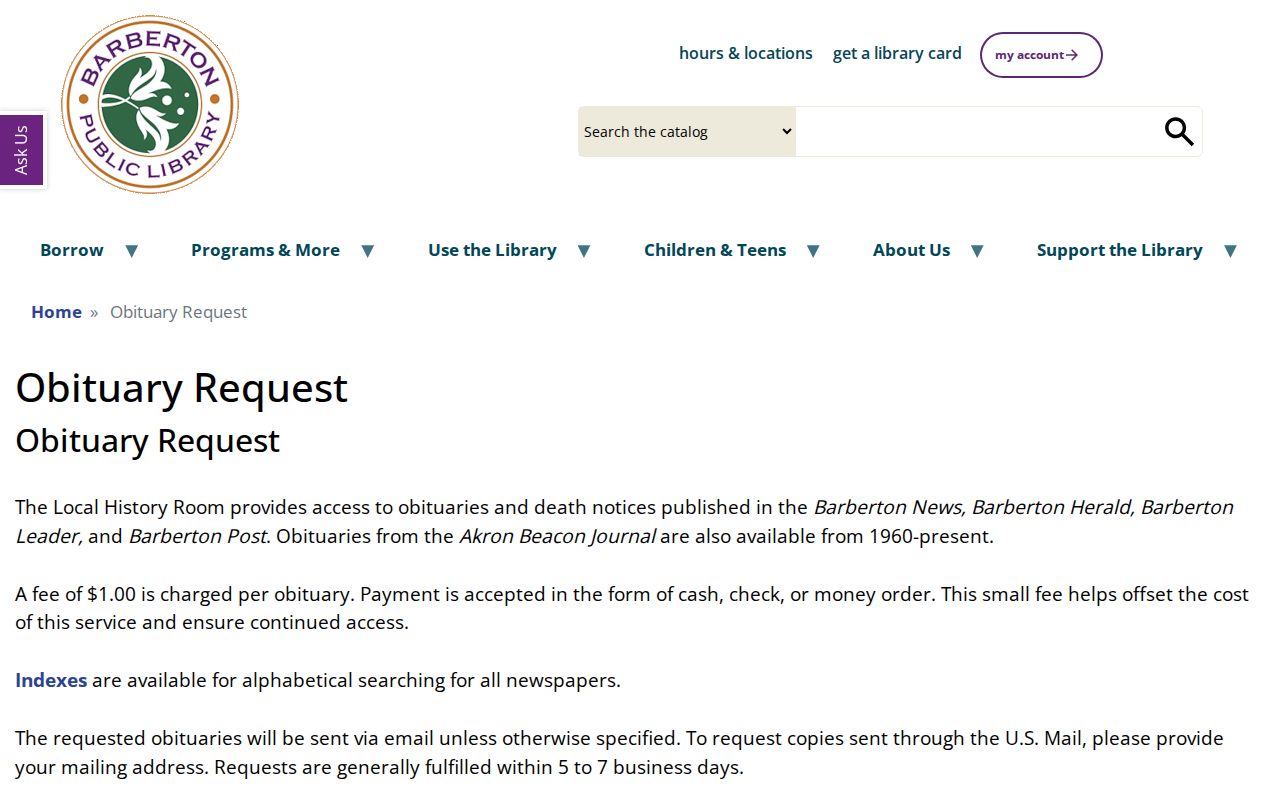
Provide the deceased person's name and the strongest available date, publication, page, or address detail so the request can be matched to the library's indexed sources.
Summit OGS cemetery records provide another assigned historical endpoint.
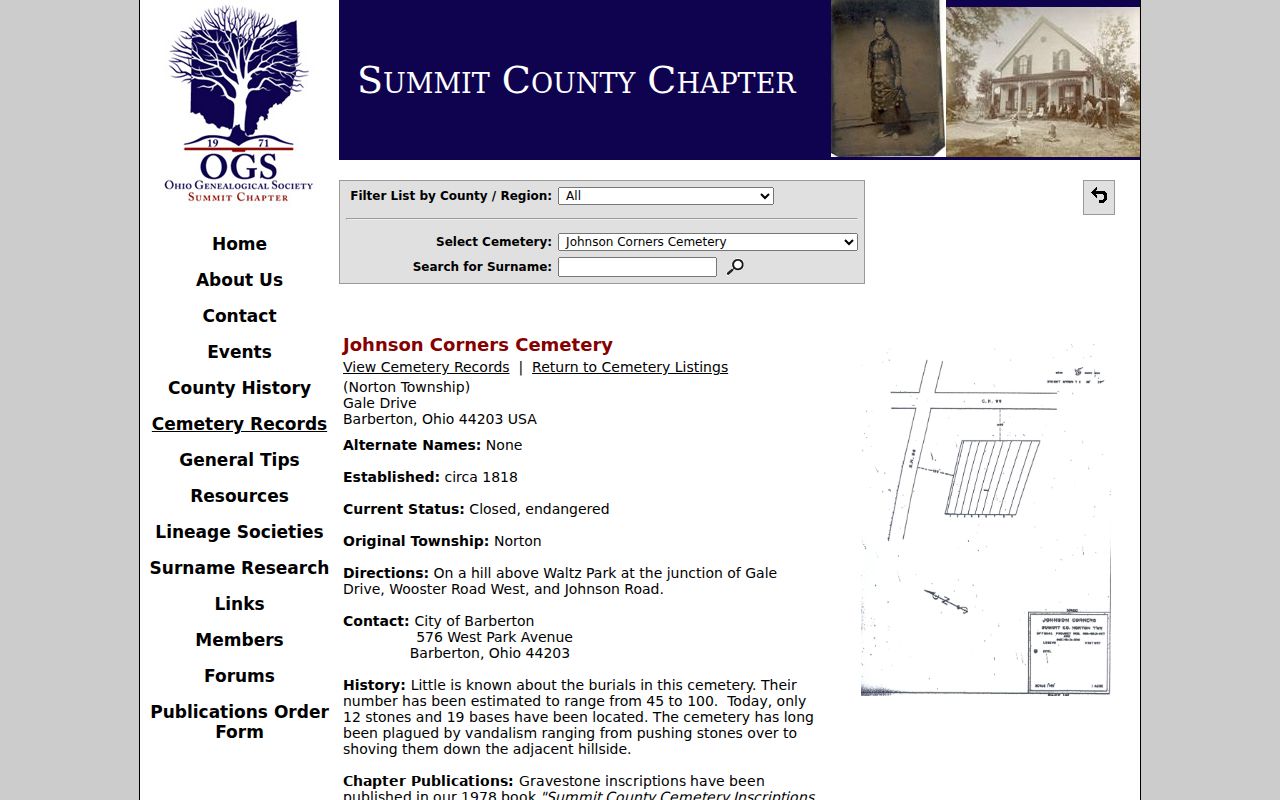
Summit OGS cautions that historic cemetery evidence can be incomplete. New Portage cemetery was destroyed and reconstructed, while the Johnson Corners cemetery record reports far fewer located stones and bases than estimated burials. Match a cemetery result with other dated evidence.
Sources Behind Barberton Previous Residents
When a record trail reaches a gap, regional archival help can be more useful than another broad search. Akron-Summit County Public Library Special Collections offers a research-request service at 60 S. High Street in Akron. Its published terms allow up to five selected obituary, article, vital, or print items in one request, with one request per month and up to three weeks for a response. Electronic delivery is free when available. Onsite black-and-white copies are listed at $0.05 and color copies at $0.25, while self-scanning is free.
The following Special Collections research-request service is the assigned source for a targeted archival follow-up.
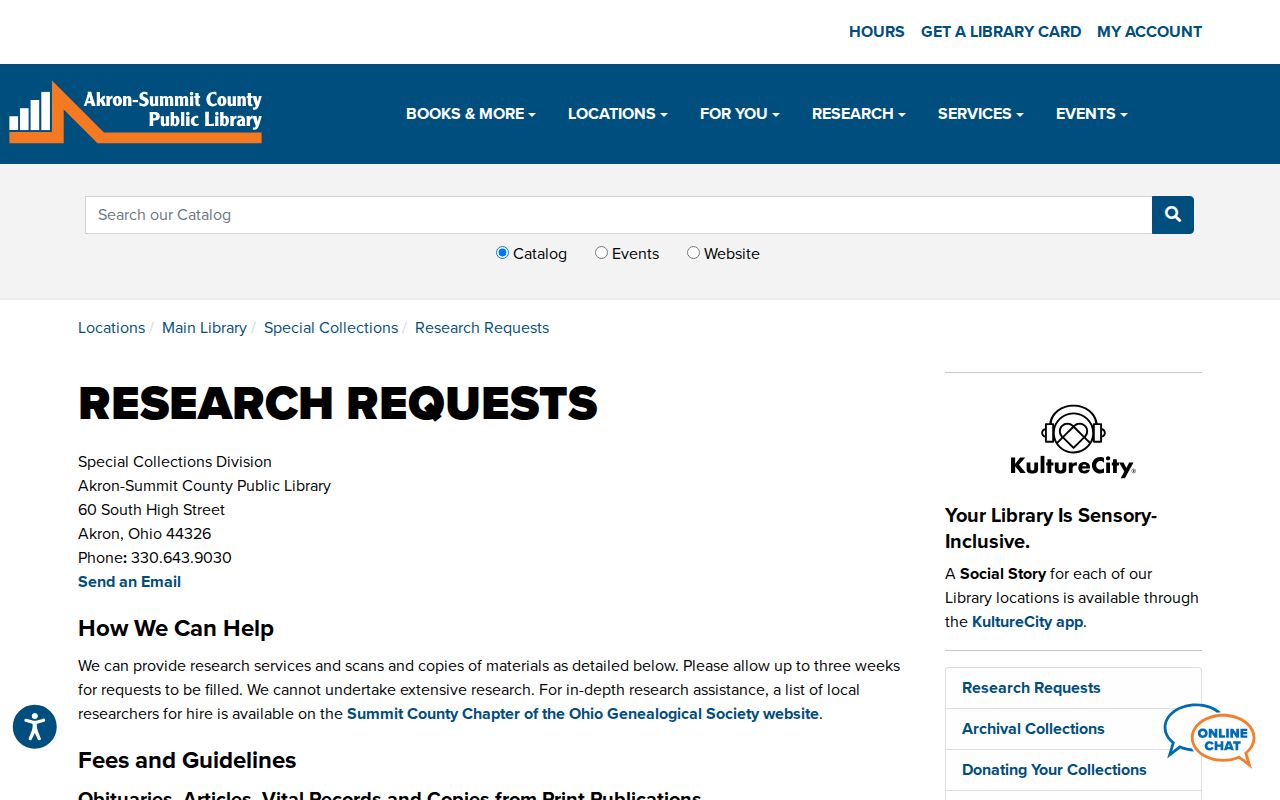
Send a narrow request with the name, address, date range, and the exact indexed item or citation when possible. The service is not intended for extensive research, so a focused question gives staff the best record target. For building or inspection material, give the project address and time period to the Barberton or Summit County Building Standards custodian, because newer building-standard records may be held there after the 2026 transfer of functions.
The FamilySearch Summit County Coroner Inquests, Hospital and Cemetery Records collection adds 11,873 indexed records and 12,047 images from 1882-1949. Its historical fields can include residence, cemetery, family, date, or informant detail, but sensitive records require careful, respectful interpretation and source matching. Barberton Public Library's Sanborn database covers more than 400 Ohio communities from 1868-1960, with city, street, or building and date search modes; ask staff to verify the specific Barberton map year because no official local year list was confirmed.
Note: A Recorder index, a directory citation, and an archive copy serve different purposes, so retain the original source route for each one.